How do pheromones interact with body temperature? Why does your cologne sometimes “smell different”?

You’ve probably experienced this:
A cologne that looks like a field of flowers in Provence on a fragrance tester turns into a sour, soapy smell when sprayed onto your wrist; a “man-slaying” fragrance recommended by a friend leaves no impression on you and even feels a bit cheap.
Are you wondering:
Did I buy a fake product?
— Probably not.
As someone who has spent a lot of time in the lab processing skin samples and analyzing fragrance reactions, I can tell you frankly: cologne is only a semi-finished product in the bottle.
The real chemical reaction only begins when it comes into contact with your skin, body temperature, and unique microbiome.
Today, we’ll break down this “invisible experiment” for you so you can understand why pheromone cologne changes in different people.
Variable 1: Body temperature (The Accelerator)
Is your body a heater or a refrigerator?
Cologne is a game about evaporation rate.
High-heat skin
If you are prone to fever, love exercise, and sweat a lot, you have a high-temperature constitution.
Chemical reaction:
Your skin is like a fully powered diffuser. The alcohol evaporates extremely quickly, the top notes (such as citrus and bergamot) disappear in an instant, and the middle and base notes are quickly brought out.
Recommendation:
Avoid extremely refreshing colognes (they have very poor longevity).
Choose wood tones or oriental tones.
Use your body heat to “bake” these fragrance notes to create richer layers.
Cool Skin
If you often have cold hands and feet and dry skin, you have cold skin.
Chemical reaction:
Your skin will “hold” the cologne, and the top notes will linger for a long time—sounds good, but the projection will be weak, and you can only smell it when you get close.
Recommendation:
You’re like a “refrigerated display case.”
The rich floral and gourmand notes are not cloyingly sweet but rather elegant and restrained.
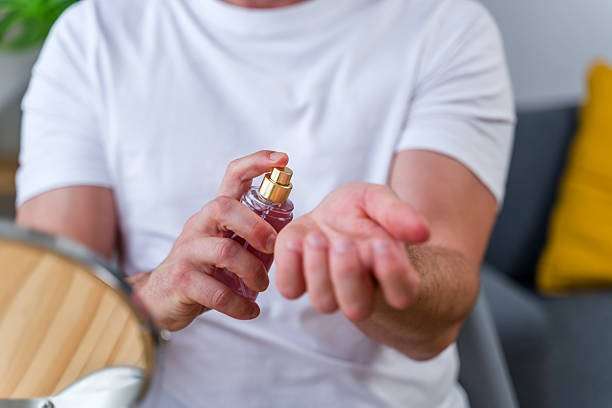
Variable Two: Skin Chemistry (The Modifier)
pH and Microorganisms: The Invisible Filter
Skin is not a smooth plastic sheet but a slightly acidic microbial ecosystem.
pH value affects the direction of fragrance notes
Healthy skin is typically slightly acidic (pH 4.7–5.5).
If it’s more acidic (pH < 4.5):
The citrus notes will be sharper, clearer, and brighter.
If it is alkaline (pH > 6.0):
The woody and musky notes will be warmer and softer, and it is easier to develop a “powdery” feel.
Microbial Metabolism: The Real Players Behind the Scenes
Hundreds of millions of microorganisms (such as corynebacteria) live on your skin.
They are not “bystanders” but active players in the transformation of cologne.
They will:
consume certain large molecules → break them down → excrete new metabolites,
ultimately changing the scent of your cologne.
This is why:
Some people smell musk as milk.
Some people smell a sour, rotten scent when they wear musk.
What truly determines the scent is not just the cologne but your unique “microbial signature.”
Variable 3: Pheromones (The Secret Sauce)
Your biological background
Pheromones are not only signals of attraction but also the “underlying filter” of cologne.
The human body naturally secretes small amounts of androstadienone and estratetraenol, which mix in sebum.
When cologne is applied, it alters the overall color temperature and direction of the fragrance.
This is why colognes containing Iso E Super (ambergris) (such as Escentric Molecules 01)
vary from person to person.
This is because its function is to amplify and modify your natural pheromones, rather than mask them.
How can you find your true “signature scent” based on body temperature, pH, and pheromones?
1. Choose a fragrance based on your skin type (Skin Type Audit)
Oily skin
Sebum has a strong ability to attract cologne molecules.
resulting in longer-lasting and stronger diffusion.
suggestion:
Spray sparingly, as it’s easy to overdo it.
Be cautious with spicy and strongly flavored notes.
Dry skin
Cologne doesn’t “stay” and easily becomes diluted and dissipates quickly.
suggestion:
A “base layer” is necessary.
Use unscented lotion or jojoba oil before applying fragrance.
This can mimic the fragrance-locking ability of oily skin.
2. pH Adjustment Method: When all your colognes feel “acidic” on your skin…
If you find that your cologne always tastes sour or doesn’t last long, the problem is often with your shower gel.
suggestion:
Replace strongly alkaline soap-based products
Switch to a pH-balanced amino acid body wash.
Protecting the skin’s lipid barrier → Cologne shows significant improvement
3. The “30-Minute Rule”
When testing a fragrance, never trust the impression you get in the first second after spraying it.
Correct way:
Spray on wrist
Go shopping
Smell it again after you get back—it will truly smell like you after 30 minutes.
Because at this time:
After the alcohol evaporates
Body temperature begins to rise
A microbial community initiates metabolism
Cologne truly blends with the skin
In conclusion: Cologne isn’t one size fits all; it’s your “liquid skin.”
Cologne can change its flavor, which is not a bad thing; rather, it is a form of creativity from your body.
Your body temperature, your pH level, your gut microbiota, your pheromones—
These are all unique in the world.
Because they are different, cologne will reveal its unique soul on you.
cologne that can “talk” to you, not the one on someone else’s body.
Cologne for you?
Welcome to check out:
Get your personalized pheromone cologne now!
